
Retiring at 50 means building a bridge: a plan for paying for spending, taxes and health insurance from your last paycheck until retirement accounts, Social Security and Medicare can take over. Most working households map where the money comes from before 59½, 62 and 65. What fits depends on your spending, your account types and your circumstances.
Who this is for: This guide is written for working households, especially Millennial families and business owners earning $250K+, who are thinking about stepping back around 50. If you are already retired and drawing income from your accounts, your situation looks different. Talk with your CPA about what applies to you.
Our post on whether $2 million is enough to retire at 50 covers the "how much" question. This one covers the "how": the order of operations once you have a target date in mind.
This post is general education, not personalized tax, legal or investment advice. Rules and figures below were checked against IRS.gov, SSA.gov, Medicare.gov and HealthCare.gov on November 24, 2026, and they may change. Dollar examples are hypothetical and for illustration only. Talk with a qualified tax professional before you act.
What Does a Bridge Plan Look Like?
A bridge plan answers one question: where does the money come from in each stretch between your last paycheck and the age when other income and coverage start? If you stop work at 50, the stretches look like this:
- Age 50 to 59½ (about 9½ years). Money taken from most retirement accounts before 59½ is generally an early distribution. It is taxed as income, and a 10% additional tax may apply unless an exception fits. (IRS Topic 558; IRS Topic 557)
- Age 59½ to 62. The early distribution rules generally stop applying, but pre-tax withdrawals are still taxed as income. Social Security is not available yet.
- Age 62 and later. You can start Social Security retirement benefits as early as 62. If you were born in 1960 or later, full retirement age is 67, and starting at 62 reduces the benefit by about 30%. (SSA, Retirement Age and Benefit Reduction)
- Age 65. Medicare is health insurance for people 65 or older, with earlier eligibility only in limited cases such as a disability. (Medicare.gov) Until then, coverage is a separate bridge of about 15 years.
Early in the bridge, spending often has to come from savings outside retirement accounts, from other income, or from a narrow set of exceptions. That is why the mix of account types can matter more than the total balance.
Retiring at 50 is not one decision. It is three timelines: account access at 59½, Social Security at 62 or later, and Medicare at 65. A plan covers the gaps between them.
How Do You Retire at 50, Step by Step?
This is the order many people work in. It is a general outline, not personal advice.
- Pin down your real spending. Use bank and card statements, not guesses. Drop work costs like commuting and add costs that grow, like health coverage. The spending math, including the 4% rule of thumb and its limits, is in our $2 million at 50 walkthrough, so we will not repeat it here. For a method that works at any age, see how much you need to retire.
- List every dollar that is not a paycheck. Rental income, business income, a spouse's earnings or part-time work can all shrink what you pull from savings. Each one comes with trade-offs, such as time, risk or a business that still needs you.
- Use your remaining working years to build a flexible mix. Pre-tax, Roth, taxable and HSA dollars behave differently before 59½. For 2026, the IRS employee deferral limit for 401(k), 403(b) and most governmental 457 plans is $24,500, and the IRA limit is $7,500. For 2027 the 401(k) limit rises to $25,500 and the IRA limit stays at $7,500. (IRS, 2026 limits, Nov. 13, 2025; IRS, 2027 limits, Nov. 12, 2026) Your plan may set lower limits, and Roth IRA eligibility and traditional IRA deductions depend on income.
- Match each stretch of the bridge to a source. The table in the next section lists the common tools and what limits each one.
- Price your health coverage. Get current quotes before you pick a date. Your income choices can change what you pay.
- Choose a Social Security approach. Decide whether your plan needs to work without it until 62, 67 or later.
- Stress test it, then take it to your CPA. Ask what happens if spending runs higher, markets are weak early on, or tax rules change. A gradual transition may fit better than a hard stop.
If your target date is earlier and you have kids at home, read what changes when you add kids to an early retirement plan.
Which Accounts Can You Use Before 59½?
Here is a category-level comparison of the sources people look at for cash flow in the first stretch of the bridge. None of these is a recommendation. Each has a limit, and your CPA can tell you which ones apply to you.
| Source of cash flow | What to know | Limit or trade-off |
|---|---|---|
| Taxable brokerage and bank accounts | No age rule on withdrawals. | Selling investments can trigger capital gains tax. (IRS Topic 409) Families who saved mostly at work may not hold much here. |
| Roth IRA contributions | IRS ordering rules generally treat your regular contributions as coming out first. (IRS Publication 590-B) | You give up that money's future tax-free growth. Earnings and conversions come later in the order and have their own rules. |
| Roth conversions | Moving pre-tax money to a Roth IRA adds taxable income in the conversion year. Each conversion has its own five-year period for the 10% additional tax if you take out the converted amount before 59½. (IRS Publication 590-B) | You need other cash to live on while you wait, and the added income may reduce Marketplace savings. |
| Substantially equal periodic payments | A series of set payments over your life expectancy is an exception to the 10% additional tax. For an employer plan, you must separate from service before the payments begin. (IRS Topic 558) | The rules are strict and detailed. Get professional help before you start. |
| Employer plan after leaving at 55 or later | Distributions after you separate from service with that employer in or after the year you turn 55 are an exception. (IRS Topic 558) | It covers that employer's plan, not IRAs, and it does not apply at 50. The exact leaving date matters. |
| HSA | Distributions for qualified medical expenses you incur after the HSA is established are generally tax-free. (IRS Publication 969) | Other withdrawals are taxed as income and may face an additional 20% tax before 65. See our HSA post for the basics. |
| Part-time or business income | Reduces how much you need from savings. | You are still working, and the income counts toward what Marketplace savings are based on. (HealthCare.gov) |
General education only. Rules checked against IRS.gov on November 24, 2026. Other exceptions to the 10% additional tax exist, such as disability and unreimbursed medical costs above 7.5% of adjusted gross income, but most do not fit a planned early retirement. See IRS Topic 558.
A balance on a statement is not the same as money you can spend freely at 50. Where it sits, and how each source is taxed, shapes your options.
How Do You Pay for Health Insurance Before Medicare at 65?
If you lose job-based coverage, HealthCare.gov lists two main options: a Marketplace plan or COBRA. You generally have 60 days to apply for a Marketplace plan after you lose coverage. COBRA usually lasts 18 months, and you usually pay the full premium plus a small administrative fee. (HealthCare.gov) A spouse's job-based plan is a third route, though if that coverage is considered affordable you generally will not qualify for Marketplace savings.
Here is the part that ties your health plan to your tax plan. Marketplace savings are based on your estimated income for the full calendar year. For the premium tax credit, household income generally has to be at least 100% and no more than 400% of the federal poverty level. (IRS, Premium Tax Credit overview; HealthCare.gov, federal poverty level) The temporary rules that removed the 400% cap applied through 2025. (Congressional Research Service) For tax years after 2025, there is also no cap on repaying excess advance credits, so a wrong income estimate may cost you at tax time. (IRS, Premium Tax Credit Q&A)
In plain terms, which accounts you draw from, and how much you convert to Roth, may change your coverage costs. Savings may not be available at your income, so price a plan with and without them. Our $2 million at 50 post covers the coverage options in more detail.
Treat health insurance and taxes as one plan. Income you create to fund your lifestyle can change the price of your coverage, and coverage costs can change from year to year.
What Should You Ask Your CPA?
This is not a DIY decision. Account access rules, Roth conversions and Marketplace income all interact, and the right answer depends on your circumstances. Bring these questions to your CPA before you pick a date:
- Which of my accounts can I use before 59½, and what would each withdrawal cost me in tax?
- Would a Roth conversion make sense in my first years without a paycheck, and how would the added income affect my health coverage costs?
- Does a substantially equal periodic payment plan fit my situation, and what happens if I need to change it?
- How should I handle capital gains in my taxable accounts as I start selling?
- If I own a business, how does a sale, a wind-down or staying on part-time change my taxes and my coverage options?
- What should I do about estimated tax payments once my paycheck withholding stops?
- Does leaving my employer at 50 instead of 55 change my options in that employer's plan?
If you want a year-end version of this conversation, our year-end tax planning checklist for high earners lists the 2026 dates.
Is It Right for You?
Retiring at 50 may work if you know your real spending, have a plan for each stretch of the bridge, and have some flexibility, like part-time income or the ability to trim spending in weak years. It may be a poor fit if most of your savings sits in pre-tax accounts, your spending is high, or you need the plan to work with no flexibility for 40 years. Every one of those depends on your circumstances.
You do not need to know all the answers today. Start with your spending and the three dates: 59½, 62 and 65. Then build the bridge one stretch at a time.
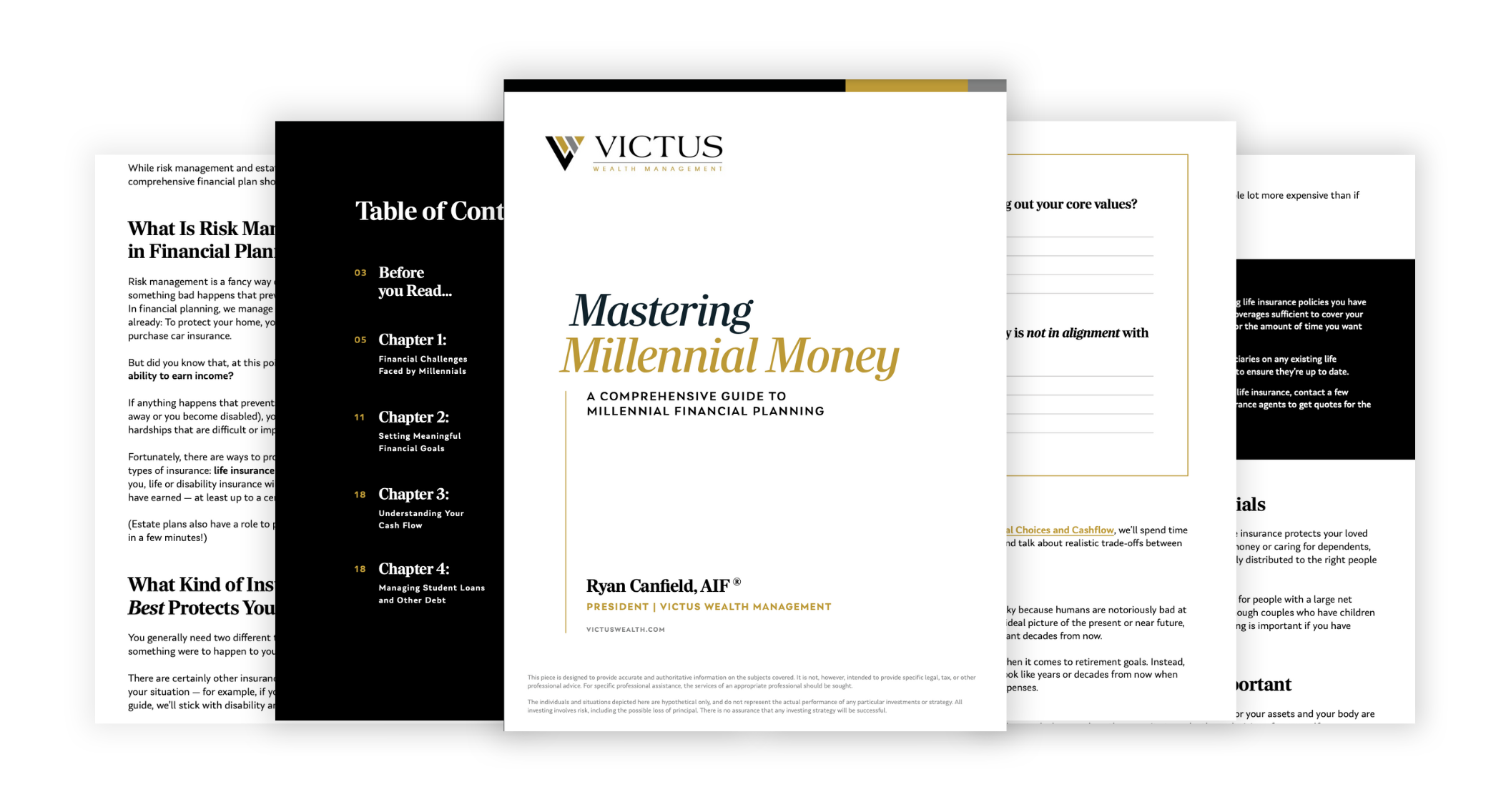
Victus Wealth works with Millennial families and business owners on retirement, tax and investment planning. If you want to talk through your timeline, Schedule a free discovery call. You can also see what we offer. If you are earlier in the process, our free guide, Mastering Millennial Money, is a good place to start with goals and cash flow.
Frequently Asked Questions
How much money should you have to retire at 50?
There is no single number. Start with your yearly spending, then decide how many years the money has to last. Subtract income that does not come from your savings. A common rule of thumb divides yearly spending by 0.04, but that is an illustration, not a projection, and it ignores taxes, inflation and market swings. A CPA or planner can test your numbers.
Is $1,000,000 enough to retire at 50?
It depends on your spending, taxes, health coverage and how long the money must last. As a simple illustration only, a 4% withdrawal from $1,000,000 is $40,000 a year before taxes, which may fall short for a family that also has to pay for health insurance until Medicare at 65. A retirement that starts at 50 can run 40 years or more, so many people plan for flexibility such as part-time income.
How do I pay for health insurance if I retire at 50?
Medicare generally starts at 65, so you need coverage for the years in between. Common options are a Marketplace plan, COBRA (usually up to 18 months, at the full premium plus a small fee) or a spouse's job-based plan. Marketplace savings are based on your estimated income, so your withdrawal plan may affect what you pay.
Can I take money out of retirement accounts before 59½?
You can, but early distributions from most retirement accounts generally face a 10% additional tax on top of regular income tax unless an exception applies. Exceptions include substantially equal periodic payments and, for an employer plan, leaving that employer in or after the year you turn 55. The rules are detailed, so confirm with your CPA first.
When can I claim Social Security if I stop working at 50?
The earliest start is 62, with a reduced benefit. If you were born in 1960 or later, full retirement age is 67. Your benefit is based on your highest 35 years of earnings, so stopping at 50 may leave years counted as zeros. When I plan for Millennial families, I typically leave Social Security out of the numbers and treat it as a bonus, not the foundation.
Sources and As-Of Dates
Government sources below were checked on November 24, 2026. The 4% rule of thumb and the dollar examples in this post are illustrations, not sourced data.
- IRS Topic 558, Additional tax on early distributions from retirement plans other than IRAs
- IRS Topic 557, Additional tax on early distributions from traditional and Roth IRAs
- IRS Publication 590-B, Distributions from Individual Retirement Arrangements (2025)
- IRS Publication 969, Health Savings Accounts and Other Tax-Favored Health Plans
- IRS Topic 409, Capital gains and losses
- IRS news release IR-2025-111, 2026 retirement plan limits (Nov. 13, 2025)
- IRS news release IR-2026-136, 2027 retirement plan limits (Nov. 12, 2026)
- IRS, Premium Tax Credit overview; IRS, Questions and answers on the Premium Tax Credit
- SSA, Retirement Age and Benefit Reduction
- SSA, Your Retirement Age and When You Stop Working
- Medicare.gov, Get started with Medicare
- HealthCare.gov, See your options if you lose job-based health insurance
- HealthCare.gov, Federal poverty level
- Congressional Research Service, Enhanced Premium Tax Credit and 2026 Exchange Premiums
This article is general education and is not personalized tax, legal or investment advice. Examples are hypothetical, for illustration only, and are not projections or guarantees of any result. Tax rules, benefit rules and limits change, and your situation may differ. Any benefit described here may be limited by eligibility rules, income levels or other trade-offs. Consult a qualified tax professional before acting.


How Does Social Security Change If You Stop Working at 50?
Social Security is not a source of cash at 50. The earliest start is 62, and starting early reduces the monthly benefit. (SSA, Retirement Age and Benefit Reduction)
Stopping early can also change the size of the benefit. SSA bases your retirement benefit on your highest 35 years of earnings, and years without earnings count as zeros. (SSA, Your Retirement Age and When You Stop Working) If you stop at 50, you may have fewer than 35 years on record, which could lower your average. Your own earnings history and estimates are in your online account at ssa.gov.
So for the years from 50 to at least 62, your savings and other income carry the full load.
How I handle it in a plan. When I plan for Millennial families, I typically leave Social Security out of the numbers. That is not a prediction that it won't be there. Nobody can say what the rules will look like in 20 or 30 years, and your benefit depends on your own earnings record. So I treat it as a bonus, not the foundation. The trade-off is that a plan built without it is more conservative, which may mean saving more or working longer to reach the same goal. It is still worth checking your estimate in your online account at ssa.gov.